
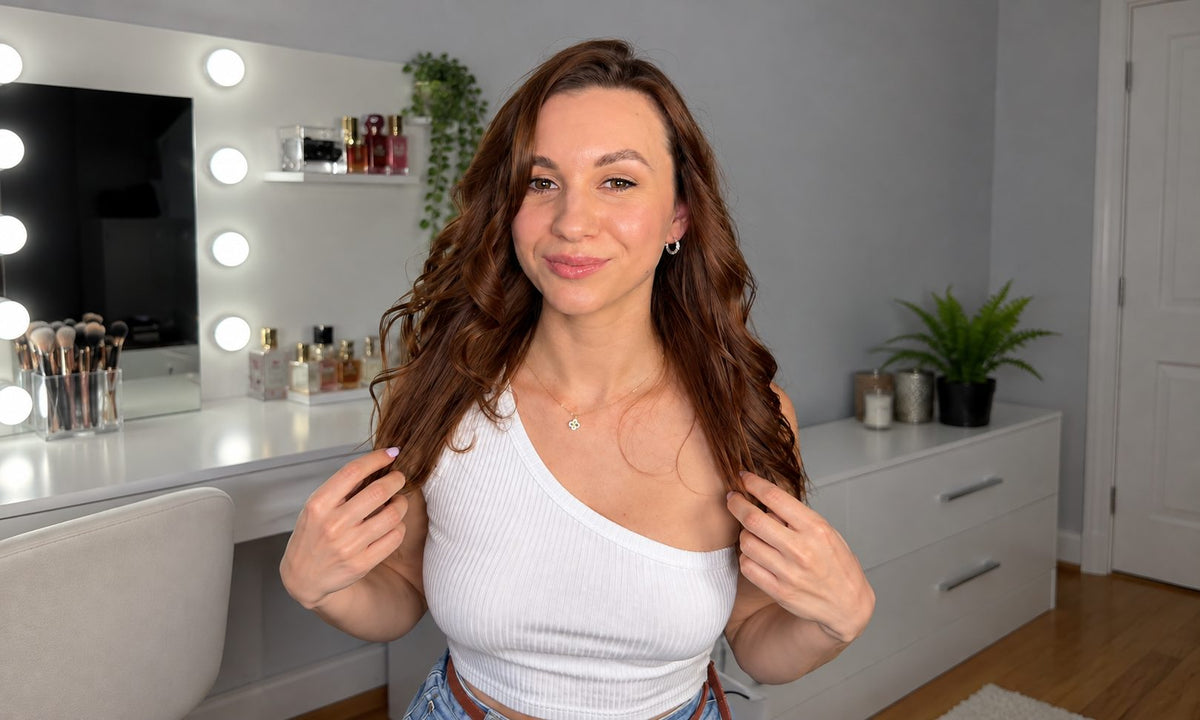
Wondering what products to use before curling hair? Learn what helps, what to skip, and how to prep curls for your hair type without weighing them down.
Your curling wand is ready, your playlist is on, and your bathroom counter is suddenly giving “beauty supply store.” Mousse? Curl cream? Oil? Hairspray? If you’re wondering what products to use before curling hair, the answer can feel like all of them...but piling on products doesn’t automatically give you curls that last.
The tricky part is that every bottle promises something different: more hold, more shine, more bounce, more main-character energy. But the wrong mix can leave your hair feeling coated, crunchy, or too heavy to hold a curl. And a routine that works beautifully for your friend’s thick, textured hair may be completely wrong for your fine strands.
So let’s make the product pile a little less intimidating. We’ll break down what different products actually do, how to choose what belongs in your routine, and how to avoid turning lovely, bouncy curls into a sticky little science experiment. We’ll talk about what everyone gets wrong...but it won’t be you anymore!
Quick answer: What products to use before curling hair
Girlies, here for the quick answer before you start styling? Let’s make this easy: you don’t need to turn your hair routine into a 10-step production. In fact, it may be much easier and simpler than you might have expected.
If you’re wondering what to put in your hair before curling, start with its condition, not a shopping list. A conditioning treatment may make sense for dry or overworked lengths, while a little oil can help smooth frizz. Both are optional; the main prep step before using a hot tool is heat protection.
-
Wash and dry: You don’t have to wash your hair right before curling. If it is a wash day, finish your usual routine and dry your hair completely before using a curling iron or wand. Applying a lightweight bonding hair oil on damp or dry hair can help smooth frizz, restore moisture, and add shine before curling.
-
Protect before heat: Apply a heat protectant according to its directions. If you apply it to dry hair, let it dry fully before curling.
-
Let curls cool: Wait until your curls have cooled before gently separating them.
Heat protectant helps protect your hair during heat styling, but it isn’t a curl-hold product. If you’re looking for products to make curls last, remember that how you curl and let your hair cool matters too, you don’t need to layer on a stack of products.


What products can you use before curling hair?
The styling aisle makes it look like every curl needs its own tiny entourage. In reality, each product has a different job, and plenty are optional. When deciding what products to use before curling hair, start with the result you want, then pick only what helps you get there.
The big distinction: products for natural curl definition - like curl creams, gels, and custards - aren’t automatically the right prep for curls made with a hot tool. And when you’re looking for products to make curls last, remember that more layers don’t guarantee more hold.
Start with heat protection; add another product only if you can name the job you want it to do.
What temperature should you use to curl your hair?
There isn’t one perfect temperature for every head of hair. Use this table as a conservative starting point, then adjust only if needed. Strand thickness and hair condition matter more than how much hair you have: a full head of fine strands doesn’t automatically need the same heat as coarse strands. Dermatologists recommend low or medium settings because excessive heat can damage every hair type.
Start at the lower end of the range. If a curl won’t form, test a small section at a slightly higher setting before increasing the temperature across your whole head. Don’t turn the wand all the way up just to make curls faster, and avoid repeatedly passing over the same section. The manufacturer’s instructions for your specific tool should always take priority.
Need more than heat protection? Choose one extra for your goal
A heat protectant covers the protection step. Any other product should solve a specific styling problem. Before adding something, ask: What do I want my curls to do that they aren’t doing now? That answer will help you choose what products to use before curling hair without building a whole product tower.
-
Want more volume? Try one lightweight volumizing styler, applied as directed. If it goes on damp hair, dry your hair completely before curling.
-
Want your natural waves or curls to show through? A curl cream, gel, or custard may suit a natural-curl routine. These products aren’t automatically heat protectants, and they’re not must-haves for curls made with a wand.
-
Want smoother-looking lengths? A leave-in conditioner may help hair feel more manageable. For extra shine, a small amount of oil or serum can be a finishing touch, but it won’t provide curl hold or replace heat protection.
-
Want extra hold? Let curls cool before deciding whether they need a finishing spray. If you use hairspray before curling, check that its directions specifically allow use with hot tools.
Here’s the little plot twist: if your curls fall quickly, adding more product may not be the fix. Try curling smaller sections, letting each curl cool before separating it, and checking whether your hair is completely dry. You may find that the best products to make curls last are simply the ones that solve a real need, plus a little patience while the curls set.

Your curling wand matters too: more heat isn’t more hold
If you’re deciding what products to use before curling hair, check your tool before adding another layer to your routine. A smooth barrel and a setting that suits your hair may help you style efficiently, but no wand makes heat damage impossible, and heat protection still belongs in the routine.
NuMe’s tourmaline-ceramic barrels are designed for smooth, consistent styling and to help reduce frizz. Some NuMe tools also let you adjust the temperature. For example, the Octowand has adjustable digital settings from 170°F to 450°F, while the Classic Curling Wand heats up to 410°F but doesn’t have adjustable temperature control.
That difference matters: temperature control lets you choose a setting for your hair instead of automatically using the tool’s maximum. It doesn’t mean you need to turn the heat up for curls to last. Start low, use the range that fits your hair’s condition, and increase only if the curl won’t form. Tourmaline and temperature controls don’t replace heat protectant, so keep using one as directed.
And before adding a stronger hold product, check the barrel size and the way you’re curling. A larger barrel creates looser waves that may relax sooner; smaller sections and letting curls cool before separating them can help the shape last. Sometimes the missing piece isn’t another bottle, bestie, it’s a better match between your hair, your tool, and the look you want.

What Products to Use Before Curling? Pick Your Hair’s Routine
The best answer to what products to use before curling depends on what your hair needs that day. Start with a heat protectant, then add one optional product only if it solves a specific problem. Here are a few low-fuss routines to try.
| If your hair is… | Try this routine | Keep in mind |
|---|---|---|
| Fine or easily weighed down | Start with clean, completely dry hair. Apply a lightweight heat protectant as directed, then curl small sections. | Skip rich creams and oils before styling if they make your hair feel flat. |
| Thick or slow to hold a curl | Apply heat protectant as directed and dry your hair fully. Work in manageable sections, then let each curl cool before separating it. | More heat and more product aren’t automatic fixes. Check your tool’s settings and try a smaller section first. |
| Dry or damaged | If you choose to use heat, apply a suitable protectant as directed and use a lower setting. Consider skipping the curling iron if your hair feels fragile or is breaking. | Don’t try to disguise damage with layers of styling products. Give your hair a break from heat when it needs one. |
| Naturally wavy or curly | Decide whether you’re enhancing your natural pattern or creating a different look with a wand. For wand styling, use heat protectant and make sure your hair is fully dry. | Curl creams and gels are usually for defining your natural texture; they aren’t automatically heat protectants. |
| Freshly washed | Condition as usual, dry your hair completely, then apply a heat protectant according to its directions. | Damp hair and a hot tool are a no-go. If your product goes on damp hair, finish drying before curling. |
| Second-day hair | Make sure your hair is dry and free of heavy product buildup. Apply heat protectant if its directions allow use on dry hair, then curl. | Don’t keep layering products over yesterday’s styling products. A little reset may work better. |
If you’re looking for products to make curls last, begin with the routine that fits your hair and give curls time to cool. If they still fall, adjust one thing at a time - section size, barrel size, or styling technique - before adding another bottle to the lineup.
So, What Does Everyone Get Wrong?
The biggest mistake is treating curls that fall as a product problem. It’s easy to assume you need a stronger spray, another cream, and a little more heat, but piling products onto your hair can leave it coated or weighed down, and turning up the temperature can add unnecessary stress. What products to use before curling isn’t about building the biggest routine; it’s about choosing only what your hair actually needs.
Start with completely dry hair and a heat protectant used as directed. Add one optional styling product if you have a clear reason, then curl in manageable sections and let the curls cool before separating them. If they still won’t hold, adjust your technique or tool before adding another bottle to the lineup. Less guesswork, less product pile, happier curls.
FAQs About What Products to Use Before Curling
What products should I use before curling my hair?
For a simple routine, use a heat protectant made for hot-tool styling and follow its directions. Your hair should be completely dry before you use a curling iron or wand. Add another product only if you have a specific goal, such as more volume, smoother-looking lengths, or extra hold.
Do I need heat protectant every time I curl my hair?
Use a heat protectant whenever you use a hot tool, following the product’s instructions. It can help protect hair during heat styling, but it doesn’t make damage impossible. Use a temperature that suits your hair and avoid repeatedly passing the tool over the same section.
Can I curl my hair when it’s damp?
No. Make sure your hair is fully dry before using a curling iron or wand. If your heat protectant is designed for damp hair, apply it as directed and finish drying your hair before styling.
What products make curls last longer?
A styling product designed for hold may help, but it isn’t the only factor. Section size, barrel size, technique, and letting curls cool before separating them can all affect how long they last. If your curls fall quickly, try adjusting one of those steps before adding more product.
Can I put oil in my hair before curling?
Only if the product’s directions say it can be used before heat styling. Oil can add shine or smooth the look of the ends, but it isn’t automatically a heat protectant or a curl-hold product. Too much may also weigh hair down.
Should I use mousse before curling?
Mousse is optional. It may be useful if your hair needs extra volume or hold, but it won’t suit every routine. If the directions say to apply it to damp hair, dry your hair completely before using a curling iron or wand.
Can I use curl cream or gel before curling with a wand?
Curl creams and gels are generally used to shape or define natural waves and curls. They aren’t automatically heat protectants, and a heavy layer may weigh down hair you’re curling with a wand. Check the product directions and use heat protectant separately when needed.
Can I use hairspray before curling?
Check the label. Some hairsprays are designed for use before heat styling, while others are better suited to finishing a style. If the directions don’t say it can be used with hot tools, save it for after you curl, and let your curls cool first.
Should I use heat protectant on second-day hair?
Check whether your heat protectant is made for dry hair. Some are intended for damp hair and need to be dried in; don’t apply one to dry hair unless its directions allow it. Make sure your hair is completely dry before curling.
Why do my curls fall out even when I use styling products?
Product may not be the missing piece. Try curling smaller sections, checking that your hair is fully dry, using a barrel size that suits the curl you want, and letting each curl cool before you separate it. If you’re using several products, buildup or weight may also be working against you.
Share:
13 Best Hair Straightening Treatments, Ranked by Hair Experts
9 Highly Effective Ways to Protect Your Hair While Sleeping