
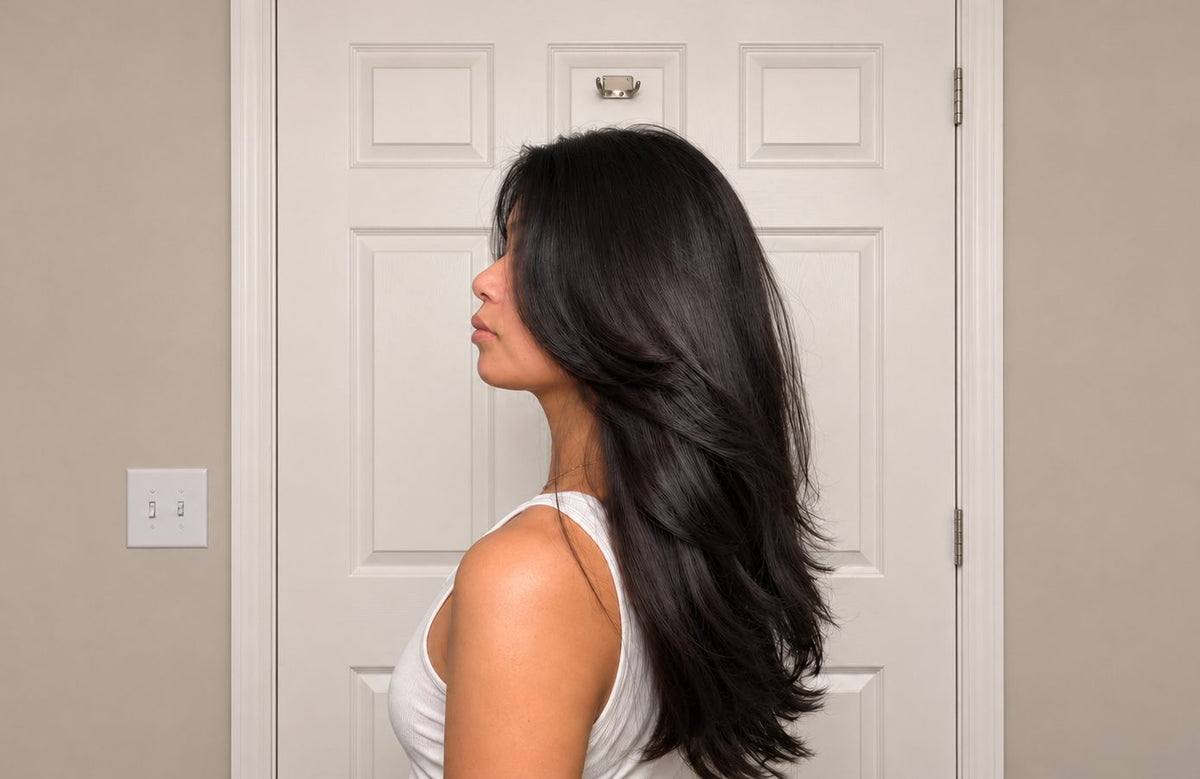
Your post-shower hair is a little more delicate than it looks, so a rough towel rub or a blast of high heat can make a simple drying routine harder on your strands. But air-drying isn’t automatically the answer, either. The best method depends on your hair’s texture, condition, and the look you want.
Learning how to dry your hair the right way is less about following one strict rule and more about a few smart choices: gently removing excess water, detangling at the right time, and using heat thoughtfully when you blow-dry. These seven expert tips will help you build a routine that works for your hair, whether you’re letting it air-dry, reaching for a dryer, or doing a little of both.
1. Blot, Don’t Rub
Your towel should be giving your hair a gentle squeeze, not a vigorous scrub. Wet hair is more vulnerable to stretching and breakage, so press a soft towel or T-shirt around your hair to absorb water. Start near the roots, then gently squeeze the lengths. Skip the rough back-and-forth rubbing, which can add friction and leave hair more tangled.
There’s a useful research finding behind this gentle approach: in a lab study of bleached hair fibers, the force needed to break a wet fiber was about 35% lower than for a dry one. That figure applies to the study’s bleached fibers, not everyone’s hair, but it helps explain why extra care when hair is wet matters. The American Academy of Dermatology also recommends wrapping hair in a towel rather than rubbing it dry.
A microfiber hair towel or an old cotton T-shirt can be handy, but you don’t need a special towel to do this well. The gentle squeeze is the important part.
Girlies, the quick tip: gently squeeze water from your hair with a soft towel or T-shirt instead of rubbing it. Wet strands are more delicate, so a little less friction can help prevent unnecessary breakage. The American Academy of Dermatology recommends wrapping hair in a towel or letting it air-dry.
2. Detangle at the Right Time for Your Texture
Wet hair is easier to stretch, so tugging through knots can cause breakage. But there isn’t one detangling rule for everyone: the American Academy of Dermatology recommends that people with straight hair let it dry a little first, while people with tightly curled or textured hair should comb it while damp. A wide-tooth comb helps reduce pulling.
| Hair type | When to detangle | Gentle way to do it |
|---|---|---|
| Straight or wavy | Let hair dry a little first. | Use a wide-tooth comb, starting at the ends and working upward. |
| Curly, coily, or tightly textured | Detangle while damp. Doing it in the shower with conditioner can help. | Work in small sections with a wide-tooth comb, gently easing through knots. |
If you hit a stubborn tangle, pause and loosen it gently with your fingers before continuing. Your hair has places to be, but there’s no need to rush it.
3. Choose the Drying Method That Suits Your Hair
Air-drying can be a lovely low-effort option, but it isn’t automatically the gentlest choice for every head of hair. The American Academy of Dermatology recommends letting hair partially air-dry when possible and limiting how often you blow-dry.
One lab study adds a helpful nuance: while blow-drying caused some surface changes in tested hair fibers, drying from 15 cm (about 6 inches) away while keeping the dryer moving caused less damage than natural drying under the study’s conditions. That doesn’t make blow-drying damage-proof; it shows that how you dry matters.
| Your routine or goal | A drying method to try |
|---|---|
| Skipping heat | Gently blot your hair, detangle according to your texture, then let it air-dry without constant touching. |
| A smoother, styled finish | Remove excess water first, apply heat protectant as directed, then blow-dry in sections with controlled heat and airflow. |
| A quicker routine | Blot well, then use a dryer with adjustable heat and speed. Keep it moving and avoid holding it close to one spot. |
If you reach for a dryer, the NuMe Signature Hair Dryer is an excellent option, with three heat settings, two speed settings, a cool shot, and two concentrator nozzles. The nozzle helps direct airflow for a smoother blow-dry.
For more styling guidance, see NuMe’s guide to a perfect at-home blowout and its article on common hair-drying myths.

4. If You’ll Blow-Dry, Start With Damp, Not Dripping, Hair
One part of learning to dry your hair the right way is knowing when to reach for the dryer. If you choose to blow-dry, gently squeeze out excess water with a towel first, then let your hair air-dry until it’s damp rather than dripping.
Important: Apply heat protectant according to its directions before you start. You can apply NuMe Clout Control to damp hair, then blow-dry to activate its anti-frizz formula. This lightweight spray creates a long-lasting shield against frizz and humidity. Powered by 18 amino acids, proteins, and vitamin E, it leaves hair smoother, softer, shinier, and more manageable.
-
Choose your brush. The NuMe Round Brush Trio includes a 32 mm brush for bangs, shorter sections, and more defined shaping; a 43 mm brush for everyday body and movement; and a 53 mm brush for longer hair and softer volume.
-
Section your hair. Clip up the top layers and start underneath, working with sections that fit comfortably across the brush.
-
Set your dryer. The NuMe Signature Hair Dryer offers three heat settings and two speeds. Start with a comfortable setting, using lower heat if your hair is fine, fragile, or chemically treated.
-
Dry each section. Place the brush underneath near the roots, keep gentle tension, and point the concentrator nozzle down the hair from roots to ends. Keep the dryer moving instead of holding it in one spot.
-
Shape and cool. Roll the brush slightly at the ends for a soft bend. Finish with the cool shot, let the section cool, then release it gently.
The Trio’s coating changes from black to white as it heats, so let the barrel cool before touching it.


5. Choose Heat and Speed for Your Hair
Part of learning to dry your hair the right way is finding a setting that gets the job done without making your strands feel overheated. For how to blow-dry hair gently, start with the lowest heat that still dries your hair efficiently, then adjust if needed.
Dryer settings aren’t standardized across brands, so “medium” on one model won’t necessarily match “medium” on another.
| Hair needs | Practical temperature target at the hair | How to adjust |
|---|---|---|
| Fine, fragile, or chemically treated | About 40–50°C (104–122°F) | Use lower heat and keep the dryer moving. |
| Average density and condition | About 45–55°C (113–131°F) | Start lower and increase only if needed. |
| Thick or dense | About 50–60°C (122–140°F) | Use airflow and sectioning to speed drying before turning up the heat. |
These are approximate, cautious targets—not clinically established limits or NuMe setting temperatures. A lab study measured 47°C (117°F) at 15 cm, 61°C (142°F) at 10 cm, and 95°C (203°F) at 5 cm from a hair sample, showing how much distance can change the heat reaching hair. Read the study.
Treat this as a starting point, not a strict rule. If your hair feels uncomfortably hot, turn the heat down or move the dryer farther away. Your goal is a comfortable, steady dry, not a race to the highest setting.
6. Aim the Airflow for the Finish You Want
The little direction change that makes a big difference? Where you point the airflow. To dry your hair the right way, match your brush and airflow to the style you’re after:
-
For a smooth blowout: Keep gentle tension with your round brush and guide the concentrator nozzle down each section, from roots to ends. Keep the dryer moving for a smoother-looking finish.
-
For extra root volume: Lift the brush up and away from your scalp as you dry, guiding the airflow along the section. Let it cool before releasing for a little extra bounce.
-
For natural curls or waves: Skip the round-brush smoothing technique. Let your hair air-dry or use a diffuser on gentle heat and airflow. The NuMe Signature Dryer doesn’t include a diffuser, so you’d need a compatible one separately.
If you’re styling waves or curls, NuMe’s hair-care guide to keeping hair frizz-free has more ideas for a soft, defined finish.
7. Let Your Hair Cool Before You Call It Done
You’re almost at the good-hair-day reveal. Before you put the brush down, check that each section is fully dry, including the roots and the hair near your nape. Then let the section cool in its shape before you brush through or touch it. If you’re using the Signature Dryer, its cool-shot button gives you a burst of cool air to finish the section.
For a smoother blowout, avoid repeatedly heating hair that’s already dry. That final pause helps you dry your hair the right way without turning your routine into an endless second pass.
Your final blow-dry check:
-
Roots and lengths feel dry, not damp.
-
No section has been held under hot airflow for too long.
-
Hair has cooled before you brush through and admire your handiwork.
Bonus Tip: Add a Glossy Finishing Touch
Once your hair has cooled, warm 1–3 drops of NuMe Gloss Boss Hair Oil between your palms, then smooth it over your mid-lengths and ends. It’s made to soften dry ends, tame the look of frizz, and add shine without a heavy finish. Start with just a drop, especially if your hair is fine, and add more only if needed.
Gloss Boss is a finishing touch, not a heat protectant, so apply your heat protectant before blow-drying.

Common Hair-Drying Mistakes (and Easy Fixes)
A few small tweaks can make it easier to dry your hair the right way and get the finish you want:
-
Rubbing hair with a towel: Gently squeeze out water with a soft towel or T-shirt instead.
-
Brushing straight hair while it’s soaking wet: Wait until it has partially dried, then detangle gently from the ends upward.
-
Blow-drying hair while it’s dripping: Blot first and let it become damp, so you’re not spending extra time drying water that a towel could remove.
-
Using high heat for the entire blowout: Start lower and adjust only if needed. Keep the dryer moving, especially as your hair dries.
-
Using too much finishing oil: Begin with a drop on the mid-lengths and ends, then add more only if your hair needs it.
Frequently Asked Questions
How do you dry your hair the right way?
Gently squeeze out excess water, detangle according to your hair texture, and choose air-drying, blow-drying, or a mix of both. If you use a dryer, apply heat protectant as directed, choose a comfortable setting, and keep the airflow moving.
Is air-drying better than blow-drying?
Not automatically. Air-drying avoids direct heat, while careful blow-drying can reduce the time your hair stays wet. Your hair’s texture, condition, and your technique all matter.
How do you blow-dry hair without frizz?
Start with damp, detangled hair and heat protectant. Work in manageable sections, guide airflow from roots to ends for a smoother finish, and avoid repeatedly heating dry sections.
What temperature should you use to blow-dry your hair?
Hair dryers don’t share a standard temperature scale, and the NuMe Signature Dryer’s settings aren’t listed in degrees. Start with the lowest setting that dries your hair comfortably, and lower the heat if your strands feel too hot.
Should you use heat protectant every time you blow-dry?
Follow the product’s directions. If it’s labeled for blow-drying, apply it before using the dryer and distribute it as directed. A finishing oil isn’t automatically a heat protectant.
Can you brush your hair when it’s wet?
It depends on your texture. Straight hair is generally easier to detangle after it has partially dried, while curly and tightly textured hair is often detangled while damp. Use a wide-tooth comb and work gently from the ends upward.
How far away should you hold a hair dryer?
Keep it several inches away and moving, rather than aiming concentrated heat at one spot. The right distance can vary with the dryer and attachment; stop and adjust if the airflow feels uncomfortably hot.
Should you apply hair oil before or after blow-drying?
Check the product directions. A finishing oil such as Gloss Boss can be smoothed over the mid-lengths and ends after styling for shine and a polished finish. Don’t use it in place of a heat protectant unless its label says it provides heat protection.
What round brush size should you use for a blowout?
Choose based on your hair length and the finish you want. A smaller barrel gives more control for bangs and shorter sections; a medium barrel adds body and movement; and a larger barrel creates softer curves and volume on longer sections.
The Takeaway
There’s no single routine that works for every head of hair. Blot gently, detangle with your texture in mind, and choose air-drying or a careful blow-dry based on your schedule and the style you want. With a little practice, you can dry your hair the right way and finish with a look that feels smooth, soft, and like you.
Share:
Can You Straighten Dirty Hair? Why It Can Damage Your Hair Faster